Sunday, 11 October 2015

Finding New Cousins

It's been an interesting couple of weeks here in the Smith/Cockram tree.  Not that I've managed to write anything I was intending to write - but I did accomplish something else.  I knuckled down and started seriously looking for some of George's living descendants, in hopes that someone among them knows something I don't know about George.

I started by looking for information about all of George's grandchildren, many of whom I knew very little about, such as, did they have any children?  And did those children have children?  And if so, where are they now?  This kind of search, as you may know, is much harder than finding information about dead people.  I hit a lot of brick walls along the way, but suddenly I remembered the existence of a book about the town and people of Indian Head, Saskatchewan, where George and his family lived for awhile.  I'd never seen this book, and didn't know what it was called or when it was published - all I knew is that one of George's daughters, Bessie Jane Fleming, had written something in it.  I wondered if she had written anything that might help me find living relatives. 


Indian Head:
History of Indian Head and District
is online here
So I went searching for the book, and found the whole thing online, what luck!  As it turned out, Bessie's little section didn't reveal anything new (except that when she was a girl, the family of eight lived for a couple of years in a rented two room house!).  But looking through the rest of the book, I found some information about Bessie's children, grandchildren, and the first names of two of her great-grandchildren.  The book was published in 1984, so the whereabouts of any of these people today was the great unknown, but at least I had some names to look for.

The next thing I found, while Googling the name of Bessie's son, was his wife's obituary.  Obituaries are often goldmines of information, and this one didn't disappoint.  It told me where Bessie's grandson and two great-grandsons were living in 2010.  So I started looking in the relevant phone books.  But that didn't work - too many people these days don't have landlines, or just put their first initial in the phone book.  So I tried Googling the names with the locations, and pretty soon I found one of the great-grandsons, with an email address!  So I got in touch, and he passed my message on to his father, my second cousin, who just happens to be interested in family history, and he passed it on to another second cousin, who is also interested.

So now I'm corresponding with Jack and Merle, two second cousins I didn't know I had, and have already been sent several pictures of George and Louisa and others in the family, that I had never seen before.  It's been very exciting to find these cousins and share information - neither of them knew that George had changed his name, but both of them are thinking about it with me now!

It's great to have company on this quest.  If you've been following this blog, you might be wondering, 'What about your cousin Donna?'  Sadly, Donna passed away a couple of months ago, and I miss her.  I wish I had found Jack and Merle when Donna was still alive - she would have been thrilled to meet them.

Tuesday, 15 September 2015

Accidently Solving a Different Puzzle

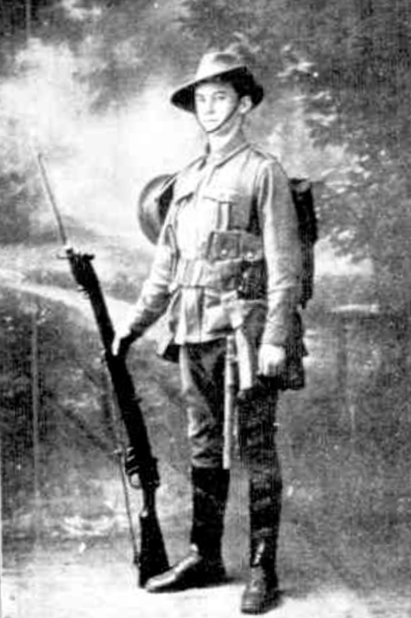
Pte Richard W Willis
from The Northern Herald, Cairns Qld, 18 Aug 1916, p.30


If you're into family tree research, you'll know how easy it is to get totally sidetracked by all kinds of distant relatives who pop up in front of your face when you're looking for someone else altogether.  It happened to me again yesterday, and I thought I'd blog about this little trip down a sidetrack, as it's a good example of thinking outside the square and finding answers in unlikely places.  I'll try to keep this long story short, but please forgive me if I rattle on a bit.

For some time I've had a woman called Rhoda Elizabeth Willis in the Australian branch of my tree as the wife of my great great uncle Alfred Cockrem, having got her name from the marriage record.  I had no luck finding any further reliable information about her.  But a short while ago I found her death record, which lists her father as Thomas Coles.  Hmmmm... was he her stepfather, I wondered? Was she married before, to someone called Willis?  Or have I got the wrong person altogether?   I put those questions aside to deal with later.

Then yesterday I was at the National Archives of Australia website, hoping to fill in a little blank about Alfred's brother, Frederick Cockrem.  I didn't find what I was looking for, but I was able to fill in my blanks about Rhoda, just by acting on a whim - when I was about to click out of the NAA website, I suddenly decided to do a quick search for the name Willis in Queensland.

One name that came up was Richard William Willis, apparently Rhoda's son. I found his WW1 service records - 42 pages of them - and on the first page, his 1915 enlistment paper, he named his next of kin as '(Mother) Mrs Rhoda Cockrem'.  But wait, I also found a letter that Richard wrote to her, addressing her as 'Gran' and her husband Alfred Cockrem as 'Dad'!  Whoa!   What's going on here? So right away, I had more questions about Rhoda than I had before, and no answers.

Richard's Attestation Paper, in which he said Rhoda Cockrem was his mother.
from National Archives of Australia: B2455, First Australian Imperial Force Personnel Dossiers, 1914-1920


I kept delving into Richard's service records, and pretty soon I had answers to questions I hadn't even asked yet, thanks to some letters between various people and the Army.  There's a letter from a Mrs Bert Kraft, asking for Private Richard Willis' address in France, who she says is her son.  The Army Records Office responded, basically saying 'please explain - we have Rhoda Cockrem as his mother, not you...'

A series of letters went back and forth on this subject, written by Rhoda, various branches of the Defence Department and Mr and Mrs Bert Kraft. (Not all of them are in the file, but are referred to.) Eventually Richard wrote to the Records Office himself, explaining that Mrs Bert Kraft was his mother, but he had hardly seen her since he was about 18 months old, and she had no claim on him.  And although he wanted to set the record straight about his next of kin, he didn't want his mother to get his 'allotment' of 4 shillings a day - he wanted his grandmother to continue getting it.

Richard's letter to the Records Office, 10th Nov 1917.
from National Archives of Australia: B2455, First Australian Imperial Force Personnel Dossiers, 1914-1920


So who was this Mrs Bert Kraft, I wondered?  More delving soon revealed the answer.  Another letter, from her husband, explained nearly everything - Rhoda had been married to a William Willis, and they had a daughter called Kathleen (now Mrs Bert Kraft). Richard was her son, born out of wedlock, and 'given up' when he was very young.  The letter goes on to offer proof of Richard's parentage, via his birth certificate, and to ask if Richard's pay is being put into a bank, and if so, which one.  Was Richard's money the only reason his mother suddenly got interested in him again?

I had to stop there yesterday, as real life got in the way - there are still many pages I haven't yet read, and I hope to get back to them soon.  But with the information I've found so far, I've been able to do some record searches today which confirm the following points:
  • My great great uncle Alfred Cockrem's wife was originally Rhoda Elizabeth Coles
  • She was born in England in about 1854, and arrived in Australia in 1873
  • She married a John (not William) Willis in 1875 
  • Their daughter Kathleen (Kate) was born in 1877, and they also had a son, William
  • Kate's illegitmate son Richard was born in 1899 (and lied about his age when he enlisted)
  • Kate married Bert Kraft in 1903
  • Richard Willis enlisted in the Australian Imperial Force in 1915 and served overseas until 1919 in 'A' Section, 6th Field Ambulance, spending much of that time in hospital with trench fever and frostbite.
I didn't know any of that yesterday morning, and I still wouldn't if I hadn't looked beyond the first page of Richard Willis' service records, which I thought I had no reason to read at all.

You just never know where that elusive information is hiding.

Friday, 4 September 2015

A New Idea about George!

I've just been reading an article called 'The Case of the False Identity'  in Inside History Jul-Aug 2013, which opened a whole new possibility for why George Cockram changed his name to Thomas Smith. 

The article relates two incidents in the 1880s where emigrants from Scotland to Australia sailed under false names simply because when they went to a shipping agent shortly before the ship was leaving, they were given tickets that had been made out for someone else, who had not shown up to claim them.  In both cases, it was just simpler and quicker for the agent to suggest that the passengers sail under false names than to write them proper tickets.

That sort of thing likely happened on many occasions, and perhaps that's what happened to George.  But if so, why did he keep the false name for the rest of his life?  Perhaps he felt that because he was making a new start when he emigrated to Canada, he might as well keep the new name too.  Possible, but is it likely?  I don't know, but it's interesting to have a whole new theory to think about.

Thursday, 13 August 2015

Down a Sidetrack: Frederick John Cockrem

Well, I said that finding Frederick Cockrem Jr's service records had given me an urge to write about him, and the urge is still with me, so here goes.

Frederick Jr had a very short life and no descendants, and I wonder how many of his relatives alive today even know he ever existed.  I want to bring him to their attention, not because he did anything remarkable, but because he's one of a huge number of young men who heard the call to fight 'for King and country' in the First World War, and lost their lives in that futile conflict.

Frederick was born in March 1900, to Frederick Cockrem and Rhoda Rhodes in Charters Towers, Queensland, Australia.  Whether his parents were ever married or not, I haven't been able to discover, but either way, his mother was out of the picture, probably deceased*, sometime before 1905, when his father married Louisa Lee. So Frederick was raised by a step-mother, along with a bunch of other children, from her first marriage, his father's first marriage, and their marriage together.

He lived most of his short life in Cairns, attended the Hambledon State School, and later worked as a carpenter.  From about the age of 13, he was a cadet in the Cairns 'Citizen Forces' (later to be known as the Army Reserve), so when the war began, he was probably very keen to go and 'do his bit'.  But of course he was far too young, only 14 at the start of the war.  Over the next three years, he may have thought the war would be over before he got his chance, so on the 5th of May 1917, he enlisted in the Australian Imperial Force and lied about his age.  At that time he would have been just over 17, but he stated his age as 18 years, 5 months.  Of course it's possible that he didn't know his real birthdate.

Frederick John Cockrem's Attestation Paper
When he enlisted, he was described as 5 feet 8 inches tall, 127 pounds, with a fair complexion, brown eyes and brown hair.  His medical examiners found him medically and dentally fit, and five months later he was on a troop ship, HMAT Euripides, heading from Sydney to England.  During the voyage, which took nearly two months, he spent 5 days in the ship's hospital with tonsilittis.

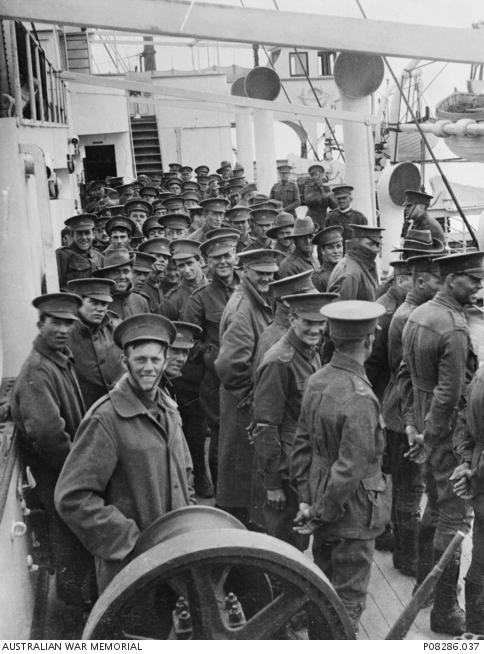
Troops line up for medical inspection
aboard the Euripides


The ship arrived at Devonport in England on the 26th of December 1917, and along with the rest of the 13th Training Battallion, Fred marched to the bleak and muddy garrison camp at Codford on Salisbury Plain, over 120 miles away.  Just a few days later, he was hospitalised again, this time with mumps.  The day after being discharged from hospital, he was back again, with measles.  Two months later he was discharged to a Training Depot, and about 10 days later, he was in hospital again, with bronchitis.


Codford Camp


On the 16th of April 1918, he was sent to France to join his unit at Calais.  Then on the 21st, as a member of the 10th Reinforcements, 52nd Infantry Battalion, he was sent 'to the field', and would finally get into the fighting.  Three days later, he was dead - one of the many Australian casualties at Villers-Bretonneux.

Nearly a year later, in March 1919, Fred's half-brother George wrote to the Administrative Headquarters of the AIF, asking why Fred's belongings had not been sent home to his father.  He received a prompt reply, stating that Fred's personal effects had been bound for Australia on the SS Barunga in June 1918, which was lost at sea, with all its cargo, as a result of enemy action.  Later information was received that Fred's effects consisted only of cards and photos.

 
Victory Medal
British War Medal


Although Fred's army career was very short and full of illness, and his active service in the field lasted only a few days, he was honoured, as were all Australian casualties of WW1, with a Memorial Scroll and Plaque, a Victory Medal and a British War Medal, all of which were sent to his father in the 1920s.  His name is engraved, along with 10,981 others, on the Australian War Memorial at Villers-Bretonneux in France.  And the sad memory of his life lives on with me, and I hope, with others in our family.

The Villers-Bretonneux Memorial, and close up showing Frederick's name.


* The only evidence I have about Fred's mother is her name on the index of his birth record, and a note on his enlistment application saying 'mother died' with no suggestion of when that happened.

Wednesday, 12 August 2015

Where were the rellies? Part 3 - the Australian contingent

Finally getting back to George's siblings after major distractions.

I've grouped Alfred, Herman and Frederick Cockram together because they all emigrated to Australia in 1882, seven years after George had gone to Canada.  They sailed together from Plymouth on the Roma and arrived at Cooktown, far north Queensland, in June 1882, aged 25, 20 and 17 respectively.  All three of them settled in the same general area of northern Queensland, from Cairns to Townsville and Charters Towers, and all three changed the spelling of their name, to Cockrem.  Then again, they might never have been sure of the spelling - it was recorded as both Cockram and Cockrem, plus other variations, earlier in the family's history.  But for these three, the change seems to have begun on the ship - they were recorded as Cochren on the passenger list.  As far as I know though, that particular version of the name never showed up again.


The most interesting thing about this excerpt from the passenger list is that it shows that the 'Cochren' brothers travelled for free.  I had previously found information that they had 'assisted passage', but this is the first indication that it was free.  How did they qualify for that much 'assistance'?  Here's what I discovered about that:

Free passages were granted by the [Queensland] Government to particular categories of immigrants, and their families, which were from time to time particularly required in Queensland. These categories altered over the years as conditions in Queensland changed but included at various time female domestic servants and married couples without children. Applicants were required to pay the sum of £1 and a similar amount for each member of the family counted as a statute adult. To be eligible, they had to be unable to pay their own passage, they could not have resided previously in any Australian colony, and they must intend to reside permanently in Queensland.  
Queensland State Archives Page 4 of 4 Dec 2014

I wonder if George had that much help when he went to Canada... but that's another story.

The trouble with Queensland is there are no existing census or 'muster' records for the period I'm interested in.  Australia didn't start a national census until 1911, and while the collated data from this and later censuses are available, no names are included.  Fortunately, Queensland seemed to produce a new electoral roll nearly every year, so at least I can glean some information from those.

Alfred Cockrem (1857-1940):

Although the eldest of this threesome, Alfred might have been the least adventurous.  Like his older brother George, he seems to be missing from the 1871 census, when he was 13 or 14.  At that age, he should have been still at home, or more likely working on a nearby farm.  But perhaps he was off somehwere with his 'missing' siblings, George and Mary Ann.  At any rate, in 1881, at the age of 23, Alfred was still single, back at home with his parents, and working as a general labourer.  The only other sibling at home at that time was Clara, age 17.

But the following year, Alfred and his brothers went to Australia.  What enticed them to go, I don't know, but I'd happily guess that Australia looked like a very attractive, warm, and wild place to young English men looking for a better life.

In 1885, when he was about 28 years old, Alfred married Maria Gibbs - but only three months later, Maria died, at only 22 years old.  By 1903, Alfred had settled about 10 kms south of Cairns in  northern Queensland.  According to the Australian Electoral Roll for that year, he was farming a property called Devon Farm, at Hambledon.  Having found him in this area, where he stayed for the rest of his life, I thought he was probably growing sugar cane, and this was backed up when I found his obituary, which states that he supplied cane to WH Swallow, the owner of Hambledon Plantation, 'in the very early days', which must have been before 1897 when the plantation was sold.

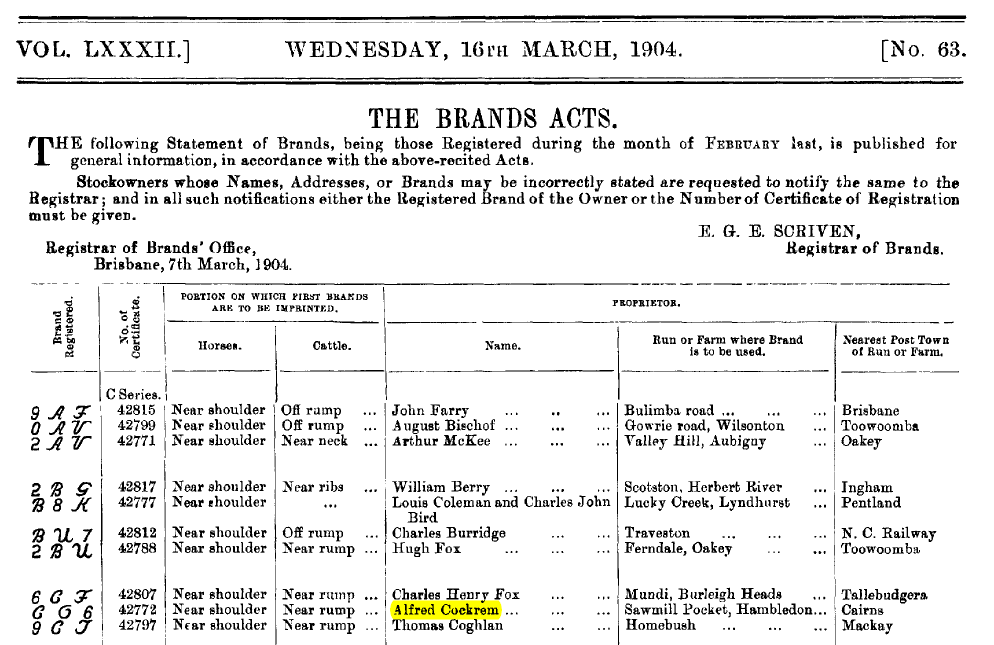
Later I found the 1919 Queensland Directory, which lists Alfred as a farmer, as opposed to a fruit grower or sugar planter. And then I found the 1904 Brand Register for Queensland, which includes one for him.  Does having a registered brand mean that he was dealing in cattle, or just that he owned some stock and was protecting them from rustling.  I don't know.


In 1908 Alfred married again, this time to Rhoda Elizabeth Willis (nee Coles), from England.  She was around 52 years old at the time, and Alfred was 51.  Later that year, and up until 1925, both of them appeared on the Electoral Roll, still farming at Hambledon.  Rhoda died in 1927, of strychnine poisoning. This sounds like suicide, but I've found no further information on that.  Alfred, who continued farming into old age, died in 1940, aged 82.

Rhoda Cockrem's death. 
Cairns Post, 16 Feb 1927, p4.
Alfred Cockrem's obituary.
Cairns Post, 9 Oct 1940, p4.


I mentioned at the beginning of this little bio that Alfred might have been the least adventurous of the three brothers.  I say that because he was at his parents' home when he was 23, and once settled in Queensland, he didn't move for the rest of his life.  But of course, he did have enough wanderlust to leave England in the first place  But I suspect it was brothers who convinced him to go.

Herman Cockrem (1862-1902):

Herman had a much shorter life than his older brother.  He was married in 1885, the same year as Alfred, to Louisa Lee.  He was 23 years old, and Louisa was 20.  She was also a British migrant, having been born in Surrey, and emigrated with her parents at the age of 18.

Unfortunately, between his marriage in Cooktown, Queensland and his death only 17 years later, little information has come into my grasp.  All I've discovered is that he and Louisa had six children, and their places of birth give me only a rough idea of where the family lived.  The first four children were born somewhere in Queensland, between 1886 and 1892, and two more children were born in Murwillumbah, NSW in 1894 and 1896.

Sometime before 1898, Herman apparently moved the family back to Queensland, as his youngest daughter Eliza died there that year, at only two years old.  His eldest daughter Clara also died young, at four years old, but the four children in between - Ada, George, William and Daisy - all lived well into adulthood.

In 1900, Herman bought a town lot of about 1/4 acre - described in the deed as 1 rood, 8.6 perches - in Cannan Street, South Townsville.  He's listed there on the 1901 Electoral Roll, and his occupation is given as 'striker'.  This is the only document I've found that lists his occupation, and unfortunately I'm not sure what a 'striker' was - he could have been a blacksmith's assistant, or someone who worked on a gang laying railway track.

Herman died in October 1902, when he was only 40 years old. The Queensland Government Gazette of February 1903 states that Herman died intestate and describes him as 'Herman Cockrem (otherwise known as Herman Cockram) late of South Townsville'. This is the only Australian document I've found that uses the Cockram spelling.

Queensland Government Gazette. 11 volumes. Brisbane: Government Printer, 1903.

 
Herman's wife Louisa lived on for another 32 years, and we'll meet her again very soon...


Frederick Cockrem (1865-1940):

Frederick was only 17 when he and his brothers arrived in Australia, and his life was the most complex.  In 1886, when he was 21, he married Mary Walsh, another British migrant about five years older than himself.  Over the next four years they had three children; William, George who died in infancy, and Cecelia.  But less than a year after Cecelia was born, Mary died.  Frederick, at only 25 years old, was a widower with two very young children, and I don't know how he looked after them.

State Library of Qld: Appointments of Queensland Railway Employees June 1890-June 1901

Just a few months before Mary died, Frederick had gone to work for the Bowen Railway as a labourer in the Maintenance department, at 8 shillings a day.  In 1892, his pay was still the same, but his job title had changed to 'lengthsman', which meant he was responsible for the maintenance of a particular length of railway line.  I'm not sure where he was living at that time, but I suspect it was Townsville.  The first definite location I've found for him was in August 1898 when he lived in Charters Towers.  In 1901 he was still there, and on the Electoral Roll his occupation is 'labourer'.

Somewhere in that period of widowerhood, he met a woman called Rhoda Rhodes, and in early 1900, Rhoda had a child called Frederick John Cockrem.  I've found no evidence that Frederick Sr and Rhoda ever married.  But Frederick Jr enlisted in the Australian Imperial Force in World War 1, and his enlistment papers tell me that his mother had died sometime before 1917.  I got seriously sidetracked by those enlistment papers and service records - over 30 pages of them - and developed a strong urge to write a bio of Frederick Jr.... but let's get back to his father.

In 1903, still living in Charters Towers, trouble struck Frederick.  I don't know what the cause was, but he declared insolvency that year.  I've found the initial record, but not the follow up that will hopefully give me a lot more information about that.

Perhaps the insolvency had to do with losing his job and having to support seven children, for besides his own three, I think he started supporting his brother Herman's four surviving children around that time.  I'm guessing about that, due to the fact that Frederick and Louisa Lee, Herman's widow, had a child, Thomas Victor, together in November 1903.  About two years after that, they got married.  And in 1907 they had another child, Alfred Henry.  At that time they were living in Cairns.

So to summarize Frederick's household as of 1907, it probably consisted of himself and his wife Louisa plus nine children, ranging in age from infancy to 19 years.

Over the next several years, Frederick and Louisa lived at a few different addresses, most of which were in the same area of Cairns.  But by 1919, they may have split up.  That year, they show up at different addresses in Cairns, and by 1928, Frederick had moved to Babinda, about 60kms south of Cairns, where he was still working for the railway, as a 'fettler' - maintaining railway track.  Louisa seems to have been living with their son Thomas in Cairns.  By 1931, Frederick was in Atherton, a little way west, and Louisa had disappeared from the Electoral Roll.  She died in 1934, and judging by a news item about her funeral, she was well-loved.

By 1936, Frederick was back in Cairns, now retired, at the age of 71, and living at the 'Pensioner's Reserve' in Martyn St.  I believe he stayed there until his death in 1940.  Frederick's obituary is very brief - it states that he lived in and around Cairns for 35 years and had been employed by the railway and by the Cairns City Council.  He was survived by four sons and a daughter.


********


Well that went on for longer than I expected it to!  I've become quite attached to all these Cockrems in the course of researching their lives.  While I doubt whether Alfred, Herman, Frederick or any of George's other siblings had anything to do with his name change, I suspect that some, if not all of them knew the reason for it.  George kept in touch with some of his siblings (unfortunately I don't know which ones) when he was in Canada, and surely he must have told them he had a new name, in order for them to be able to write to him.  And no doubt he would have explained why.

So I live in hope that at least one of his siblings happened to pass that information on to at least one of their children, who passed it on... etc.  If the reason for the name change was interesting enough, it could have become a bit of a legend amongst the Cockram/Cockrem descendants, of whom there are many, and I hope to make contact with some of them one day.  To that end, I'm currently compiling a list of all the names I know of in the descendancy, in Australia and in England, and I plan to send out a signal to them, one way or another...  If you are one of them, please contact me!


Thursday, 30 July 2015

Where were the rellies? Part 2

Right, it's time to have a look at George's parents and numerous siblings to see what they got up to that might have had something to do with George changing his name and/or leaving the country.

George's parents, William Henry Cockram (1820-1899) and Prudence Yeo (1822-1908):
William was born in Stoke Rivers, northern Devon, the eldest of seven children of William Cockram Sr and his wife Thomazin Hoyle.  He worked as an agricultural labourer from at least the age of twenty, and probably earlier, staying in Stoke Rivers until after he married Prudence Yeo in 1843.  They raised their children in Bickington and later moved a short distance to Fremington.  On various censuses, William's occupation is given as agricultural labourer, labourer, and later, a lighterman in Fremington.

I mentioned in an earlier post that Prudence was an illegitimate child of Elizabeth Yeo, and that she had a daughter about a year before she married William - other than that, I know nothing about her. The only potentially 'controversial' thing I've found about William is that he may have been accused of stealing a chicken in when he was an 'old man' in 1891.  But I strongly suspect that was another William Cockram.  So if William or Prudence did do anything that somehow upset George, I still don't know what it was.

George's siblings in a nutshell


Elizabeth Yeo Cockram (1842-1893):  Elizabeth married John Ellis in 1861when her brother George was only ten years old. In about 1869, the Ellis family moved to Swansea, Wales, where John was an agricultural labourer.  John died in 1881 and Elizabeth remarried.  She and her new husband, James Taylor returned to Fremington, living next door to her parents.  Elizabeth died in 1893.

Thomas Cockram (1845-1907):  I've always imagined that George's choice of his new name, Thomas, came from this brother.  If George was fond enough of Thomas to adopt his name, it's highly unlikely that Thomas did anything that sent George running.  But he may have encouraged George to find new horizons overseas, and inspired him to use a new name.  Thomas didn't do anything so adventurous himself though.  As a young man he worked as a carter and boarded with other families in Fremington. In 1871 he was working as a railway porter and boarding in the outskirts of London with James and Eleanor Knowles and their daughter Elizabeth, who he married in 1874. She died only four years later, and for some time, Thomas' sister Mary Ann lived with him and his two children in Kingston on Thames.  When he was 40 years old, Thomas married Frances Deakin.  He spent his whole adult life working for the railway as a porter, and died at the age of 62.

Mary Ann Cockram (1847- aft 1911):  Mary Ann never married, as far as I can tell, and worked as a servant of one type or another from the age of 14 up until my last sighting of her at age 44.  Most of her life was spent in Devon, but as mentioned above, she spent some time as Thomas' housekeeper in London when he was widowed.  In 1891 she was back in Devon, working as a housemaid, along with her sister Lucy, for the Macaulay sisters in Littleham.  And then she drops off the radar.  I'm intrigued that like her brother George, Mary Ann appears to be missing from the 1871 census.  Some day, will I find the two of them together somewhere? (updated info in a newer post)

John Cockram (1849-1932): There were a lot of John Cockrams in Devon in the 1800s and I'm not sure I'm on the trail of the right one - but I do know that John was working and living on a farm by the age of 12.  If I've got the right John after that (and I think I do), at some point he went to Wales, and I have to wonder if this had anything to do with his sister Elizabeth going there - he may well have gone at the same time.  He married twice and worked as a beer bottler in a brewery in Glamorgan, then ran the Bridge Inn public house. After his second marriage in 1894, he and his wife Minnie Hawkridge returned to Devon, where they ran a pub on The Strand in Barnstaple. By 1911, they had moved to Islington in London, where John was a 'beer retailer' - does that mean he ran a pub?  He died at 84 years old, back in Devon in 1932. (updated info in a newer post)

William Cockram (1853-1910):   William is the only Cockram who I'm certain was in the military.  He joined the Navy in 1869 at the age of 15, and served for at least 5 years.  In 1871 he was aboard the Caledonia in Naples, Italy on census night.  (If only I had found George there too....).  Perhaps William's tales of adventures at sea gave George the travel bug - who knows? After 1873, William is very hard to find amongst other William Cockrams.  I think he died in 1910 in Devon, but am not sure.

Richard Cockram (1855-?):  Richard may well have died before he reached manhood.  In 1871, at the age of 16, he was working as a ploughboy at a farm in Yelland, Devon.  And that's the last I've found of him.

Alfred (1857-1940), Herman (1862-1902) and Frederick Cockram (1865-1940):  These three brothers emigrated to Australia. I'll discuss them in a separate post. 

Lucy Cockram (1860-aft 1911):  In 1871 Lucy was only eleven years old, and not likely to have had much influence on her missing brother George.  She spent much of her life in various service jobs in households around Devon.  By 1901, after her father had died, she was living with her mother in Fremington, and five years later, at the age of 46, she married Henry Turner.  In 1911 they were living in the neighbouring county of Somerset, where they were the stewards of a golf club.  And then they both disappeared...

Clara Cockram (1864-1950):  Clara was thirteen years younger than George, but I suspect he was fond of her, as he named his first child after her.  Like her sisters, she worked as a housemaid when she was a young girl.  In 1894 she married Henry Moran in London, and lived there, in Islington for the rest of her life.  She and Henry, who was a commercial traveller selling scientific instruments, had four children.  Henry died in 1927, and Clara lived on for another 23 years.  When she died in 1950, she left an estate of 1200 pounds to her children.

These are very quick sketches of George's siblings' lives.  For a few of them, I have no more information, and for those who I do know more about, there's nothing to indicate that any of them ever got into any kind of trouble or did anything outrageous.  But of course I can't discount the possibility.  In any case, as I mentioned in an earlier post, I think it's unlikely that George was estranged from any of them, as so many of their names were passed on to his children.

Monday, 13 July 2015

Where were the rellies? Part 1

Besides good old Uncle George, I wonder if anyone else in George's or Louisa's family had some influence on their decision to emigrate.  What were all those siblings etc doing in the early 1870s?

First, a look at Louisa's family.  Before I begin, I need to clarify that her mother's maiden name was spelled in a variety of ways in different documents - Tremain, Tremaine, Tremayne, Tramain etc. I usually stick with Tremayne, but when I'm referring to specific records, I use the spelling in the record.

Louisa's mother, Jane Tremayne: I've previously mentioned Louisa's mother, who may or may not have married Louisa's father.   As a young girl, she might have got into a spot of bother.  I found a record from 1847 of a 12 year old Jane Tremain who was charged with larceny, along with three boys, age 15 to 17.  The boys were all acquitted, but Jane was sentenced to 2 weeks in jail.  I'm not positive about Jane's birthdate, but she would have been  around the right age, probably closer to 14, but she might have lied about her age to try to get let off the charge.  By the 1870s, Jane was calling herself a widow, working as a laundress and living in a lodging house with Louisa.  They may have continued living together after Louisa got married and George went to Canada on his own.

Louisa's sister, Jane Tremayne or Murphy: Young Jane is a mystery, but as I mentioned in an earlier post, she apparently ended up in Canada too.  I don't know when she emigrated, but if she went before George and Louisa did, she might well have encouraged them, and her mother, to emigrate.  Louisa's mother followed George and Louisa to Canada in 1877, apparently travelling alone.  Young Jane might have gone before, or after.  Until I discover for sure what young Jane's married name was, I won't know any more about her.

Louisa's maternal grandparents, Grace Dunn and Nathaniel Tremayne: Louisa's grandmother Grace, lived her whole life in Mevagissey, Cornwall. She and her husband Nathaniel had five children of whom Jane, Louisa's mother, was the youngest.  Nathaniel, an agricultural labourer, died in 1857, after which Grace went to work as a fishmonger, and later a domestic servant - in 1871, at the age of 75, she was still working.  She died in 1873.

Excerpt from 1871 UK Census for Grace and Sarah Tremaine, living in River St, Mevagissey and both working as domestics


Louisa's aunt, Sarah Tremayne:  Sarah, Nathaniel and Grace's eldest child, never married.  She worked as a domestic servant and lived with her mother until Grace died.  On the 1881 census, when Sarah was 57, she was marked as an 'imbecile', although she was still working, and living on her own.  Prior censuses had given no hint that there was anything wrong with her.  Like her mother, Sarah lived her whole life in Mevagissey, and died there in 1890.

Louisa's aunt, Harriet Tremayne: Harriet, born in 1826, also spent her entire life in Mevagissey, living in the same street where she was born.  She married William Whitford, a coal porter and later a fisherman, in 1856, and they had four children.  She died in 1888.

Louisa's uncle, William Tremayne: William is a little more interesting, but also harder to pin down.  He was born around 1828 and lived in Mevagissey until at least 1851.  He may have joined the Royal Marines - the 1861 census lists a Private William Tremain, born in Mevagissey at about the right time, married, serving aboard the HMS Conqueror.  This ship was wrecked later that year, in the Caribbean, with everyone on board being saved.  I haven't yet located a wife for William, and don't know if this is the right person or not.  The age given in this census record is a little off, but that's not unusual in censuses.  As far as I can discover, there were no other William Tremaynes born in Mevagissey within the same time frame.  There is no Royal Marines Service Record for William Tremayne, even though the census is evidence that he did serve - but I've just discovered that the records don't include anyone who had left the Marines before 1884 (see my previous post Was it all about Louisa? ).

HMS Conqueror.  William may have served on her, travelled to the Caribbean, and been rescued when the ship sank.

Louisa's uncle, John Tremayne: John was born in about 1830.  He married Ruth Glanville in 1865, had a few children and was a labourer, living in or near Mevagissey all his life - and may or may not have got up to a bit of chook rustling. In 1869 a William and a John Tremain were charged with stealing chickens from two different people in the parish of St Ewe, which is about 3 miles from Mevagissey. They were tried at the Quarter Sessions in Bodmin, and both were acquitted. Their ages were 40 and 38, and they were both labourers.  They may or may not be the right William and John Tremayne - I like to think they are. However, I very much doubt that Louisa would have needed to leave the country because her uncles were would-be poultry thieves.

A transcript of William and John's poulty-stealing charge.  See the handwritten note below John's name - although the typed record says they were acquitted, the handwriting seems to say: 'Summarily convicted Apr 69 Stealing ?Brocoli? at St Ewe. 1. C? Mo(nth) Hard Lab(our)'
 I haven't looked into Louisa's Tremayne cousins yet - they're on my 'to do' list.  And there's no point in speculating about what Louisa's mysterious father and other Murphy relatives were up to in the early 1870s.  He had died before 1871 (if Louisa's mother's census information for that year can be believed - which I don't) and I have no idea who the rest of them were.

But what about George's family?  He had eleven siblings, and by the 1870s, most of them had left home - where were they and what were they doing?  That's for the next post...