Sunday, 12 July 2015

Was it all about Louisa?

Just because I can't find any record of wrongdoing by George Cockram aka Thomas Smith, that doesn't mean he didn't do any!  I may sound like I WANT to find out he was a cad and a bounder, but really, I don't - this is my great-grandfather I'm talking about, and although I never met him, I've grown quite fond of him while I've been trying to piece his life together.  No, I don't wish for devillment, I just wish for answers.

Thankfully, I'm not alone in this quest.  My cousin Donna has been asking questions about George for much longer than I have, and she has one or two interesting theories about him.

First, she thinks perhaps George really was in the Royal Marines - he could have joined when he was 15 years old in 1866, and he would have had to sign on for five years, so he would have been discharged in 1871, perhaps just at the time the census was being taken.  If he was at a loose end accommodation-wise just then, it's possible that he could have slipped through the net, and that's why we can't find him in that census. And perhaps it was his time in the Royal Marines that gave George the wanderlust that eventually took him to Canada.

UPDATE:  I've just discovered that IF George was in the Marines, the reason I can't find any records for him is that the Royal Marines' Service Records available at the UK National Archives were originally created in 1884 but include records created retrospectively for anyone who had joined earlier and was still serving in 1884.  George was long gone by then - so there is a real possibility that he was in the Royal Marines.

Whether he was ever in the Marines or not, his 1875 marriage record tells us that at some point George took up residence in Notte St in Plymouth, which is the same street where Louisa and her mother lived in 1871, and may even have been the same lodging house.  Perhaps that's where he and Louisa met.  Maybe George worked in Plymouth's main industry, shipbuilding, or he may have been a labourer on the docks, loading and unloading ships' cargo.  Living and working in a seaport, it seems likely to me that he might have met men who had been to Canada, and who spurred his desire to go.
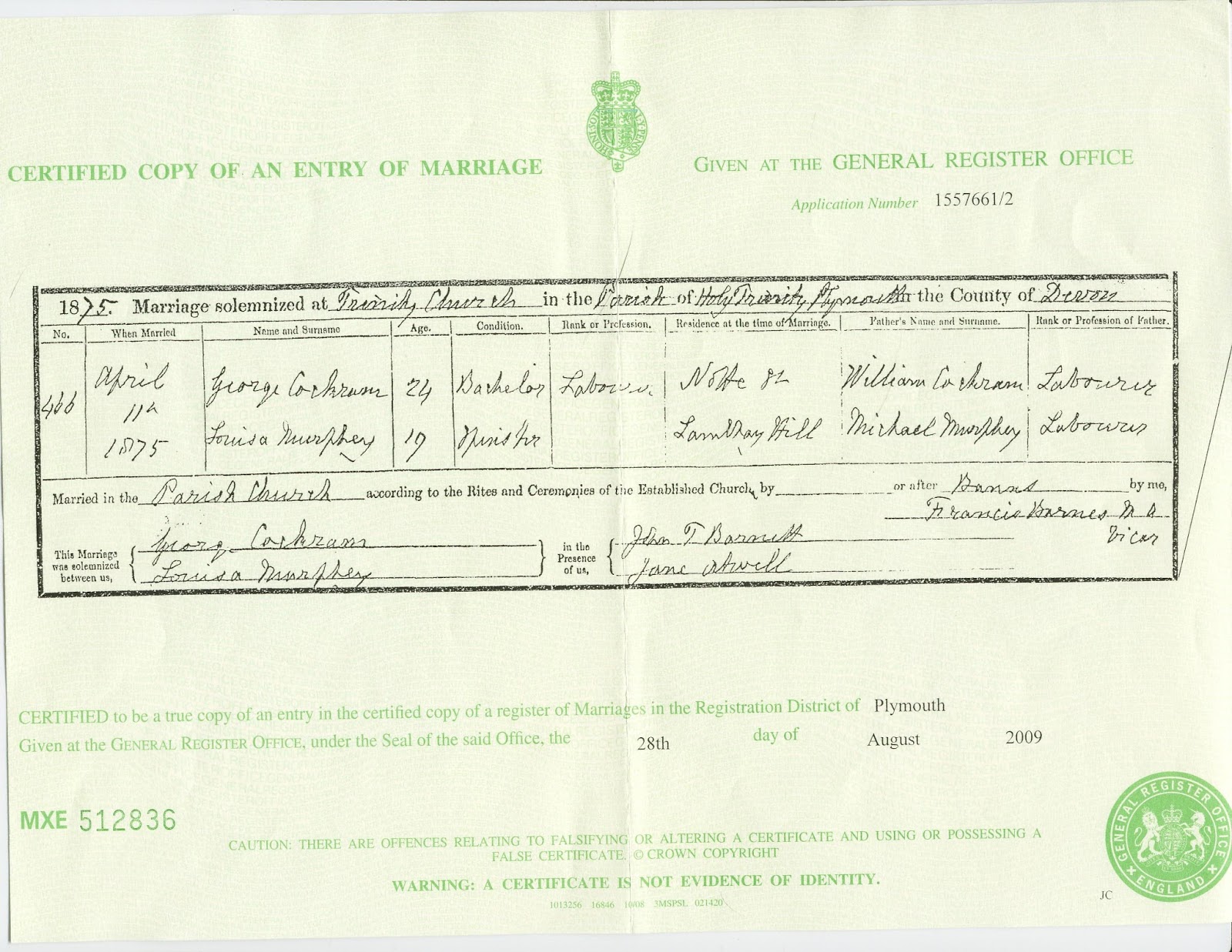
George and Louisa's marriage certificate, showing George living in Notte St and Louisa in Lambhay Hill.  Note the name of one of the witnesses - Jane Atwell (at least I think it says Atwell) - this might be Louisa's sister, who as I mentioned earlier, disappeared off the radar.  So far I haven't found a Jane Tremayne/Murphy who married someone called Atwell, but I'm still looking - if she has living descendants, one of them might hold the key to the Cockram/Smith mysteries.


Second, Donna wonders if George and Louisa were running from Louisa's father, Michael Murphy, or someone else in his family.  We know virtually nothing about them, unfortunately, so this is mere speculation, as is another idea - that Louisa's first child, Clara, was not George's - her real father was someone nasty that Louisa had been entangled with, and she wanted to get away from him, and make sure he couldn't find her or the baby.  Either of these ideas could explain why George changed his name - it wasn't him who needed to 'hide', but Louisa!  Of course she had already changed her name when she married, but a second change would hide her from people who knew her married name.

I like the way Donna thinks.  If anything is ever going to lead us to the truth of the matter, it will be ideas like these, I'm sure.

Whatever it was that led them to leave England and change their names, Donna thinks that George and Louisa didn't leave home without some regret, or at least a need to keep some kind of link with their former lives.  This thought comes from the fact that so many of their children's names can be traced back to specific people in their families.  Consider this - of their eleven children, at least seven  had first and/or middle names that came from close family members. 

George and Louisa's children:
Some of the untraced names here may have come from the Murphy family, but we have no idea who they were.  My grandfather's name, Ryley, is the most intriguing of them.  Surely there's an Irish connection there...  Should I be searching for a Ryley Murphy who had a son or a brother called Michael?  Oh god, there's another thing to put on my 'to do' list.

Anyway, to get back to the point, these names do suggest that George and Louisa both had fond feelings for people they had left behind, or at the very least, that they certainly weren't estranged from them.  It's somehow reassuring to believe that George was close to the Cockrams, despite the distance.  And Louisa was literally close to her mother, who also emigrated to Canada, about a year after George and Louisa did.  As for her missing sister Jane, Donna has been told that she went to Canada too, and lived somewhere in Ontario.  Her mother lived sometimes with George and Louisa, and sometimes with Jane's family.  I do wish Jane would pop her head up and wave at me....

Saturday, 4 July 2015

What about Uncle George? Part 2

My husband may be thrilled to believe that my youthful great-grandfather 'got some girl up the duff and scarpered to Canada', but I'm not at all convinced that he did.  Or that his Uncle George did either.

I've had no success linking Elizabeth Grant to either of my Georges - although I probably found the right Elizabeth Grant, in several census records.  She was born in 1837, which almost certainly leaves young George out of the picture, as he was 13 years younger than her.  Apparently she lost her parents at an early age and was brought up in Barnstaple by her grandparents, left the area quite soon after her baby was born, spent most of her life as a lady's maid, and eventually got married when she was over 50.  Interesting, but absolutely no evidence that either of my Georges ever knew her.  And then again, she might not be the right Elizabeth Grant!  It's all too hard...

As for the solicitor who represented George Cockram in this case, I definitely found him.  His name was John Arnoll Thorne, the son of Henry King Thorne and Susan Arnoll.  Uncle George's grandmother Thomasin Thorne had a brother called Thomas, who might have been John Arnoll Thorne's great-grandfather, but I can't find any evidence that makes that connection.  If John Thorne was related to my Georges, the nearest relationship he could have would be second cousin once removed to Uncle George, and third cousin to young George.  This is going to have to go on the backburner for awhile, as it's doing my head in, wandering down a lot of Thorne dead ends.  I need to go to England to look at records that aren't available online, and that's not likely to happen.

A word about the case relating to stealing salmon in Chulmleigh - I've dismissed this as a likelihood, as there were a couple of other George Cockrams living in Chulmleigh around that time, and the salmon stealer was far more likely to to be one of them than one of mine.

So let's move on to the other newspaper articles I found, all of which I think relate to Uncle George.  The first is from the North Devon Journal, Sept 10 1868, page 4:


A parliamentary election was coming up, and in Barnstaple, a committee was formed to work for the election of Thomas Cave and W Herbert Evans.  Among the approximately 250 names listed as members of the committe, is George Cockram of Boutport Street.  I'm reasonably confident that this is Uncle George, as I know he lived in Boutport Street in 1871 when the census was taken, and he was the only Cockram in the street.

Extract from 1871 UK Census, showing George Cockram, coach maker, and his wife Ann in Boutport Street, Barnstaple, with a lodger by the name of Caroline Beer.  Is it just a coincidence that 20 years later John Thorne's father had a servant called Emily Beer?  Probably.

If it is indeed Uncle George on the committee, this tells me a thing or two about him.  On the same page of the newspaper are 'campaign' articles by the two candidates.  They were members of the new Liberal Party, which favoured social reform, personal liberty, reducing the powers of the Crown and the Church of England (many of them were Nonconformists) and an extension of the electoral franchise.  So I assume that Uncle George held with these views.  I also assume that he wasn't any kind of a rogue, or he wouldn't be on the committee - not too likely that he was charged with being the father of an illegitimate child just a few months earlier.

The next article doesn't really tell me much, but I'll add it anyway.  This is from the North Devon Journal, Oct 7 1869, page 5:


Here, George Cockram was on a jury.  At that time only male property owners between the ages of 21 and 70 could sit on juries, which doesn't tell me much except that it couldn't have been young George, and if it was Uncle George, he owned his house.  I'm interested to see that there was also a Thomas Geen on this jury - he was very likely Uncle George's brother-in-law. And the name Beer shows up here again too, but doesn't shed any light on anything. By the way, this case, about a stolen pair of boots, was written up in great detail, including the fact that the judge complained about the length of time the case occupied.  The female defendant, Eliza Hill, was acquitted on the grounds that she was acting under the influence of her husband Francis. He was sentenced to six months hard labour, and his brother William to seven years.  All for a pair of boots.

Just one more thing, which I found in the Manitoba Free Press, Jan 1, 1907, page 14, in an article about upcoming civic elections in Ontario.


Uncle George and his wife lived in the town of St Thomas, Ontario, where he worked as a railway car inspector from at least 1891 to 1911.  And here is his name amongst the list of men running for aldermen in that town.  It seems that he didn't win, as his name doesn't seem to show up after the elections, but the fact that he was in the running suggests that he was a respected person in the town.


So to sum up the results of my newspaper search, as inconclusive as they are, it seems that neither George nor his Uncle George ever got up to any serious mischief  - or at least they never got caught getting up to anything.

As for my question about whether Uncle George influenced and/or helped young George to go to Canada, I haven't found a shred of evidence one way or the other.  As far as I can tell, they never lived nearer than about 200 miles from each other in Canada.

So for now I'll leave Uncle George inspecting railway cars in Ontario, and get back to concentrating on young George aka Thomas Smith.

Wednesday, 1 July 2015

What about Uncle George? Part 1

I recently realized that George wasn't the first person in his family to emigrate to Canada - he had an uncle, also called George Cockram, who did the same in 1873, two years before George.  This revelation led me to consider two theories:

1) Did Uncle George find life in Ontario, Canada so much to his liking that he encouraged, and perhaps helped his nephew to join him there?
2) Or was Uncle George the black sheep of the family?  When young George went to Ontario, did he change his name so as not to be mistaken for his nefarious uncle?

These both seemed like good leads to follow up, so in the last couple of days I've been looking for any evidence that would back up either theory. Uncle George was born in 1838, and lived in Devon until 1873, when he left England.  Nephew George left in 1875, so I was looking at Devon newspapers between 1845 and 1875, to cover both Georges.

Of course I went down the most interesting path first, and looked for one of them as a bank robber, molester of women, sheep rustler or anything else along those lines.  I only found two articles of interest, but with not enough information in them to assure me that they are about either of my George Cockrams.

The earliest article is in the 'Chulmleigh, County Magistrates Petty Sessions' column of the North Devon Journal, January 20th, 1859, page 5:


Uncle George would have been nearly 21 years old at this time.  I don't know whether or not he lived in Chulmleigh, as he's missing from the 1851 census, and in 1861, he and his widowed mother were visitors at a friend's house in Barnstaple on census night. But Chulmleigh is only a few miles south of Stoke Rivers, where he was born, and Barnstaple, where he lived later, so it's certainly possible.  But I have a strong feeling that this is another George Cockram altogether.  And by the way, the name Cockram is a very common one in Devon, and the number of George Cockrams born there in the 19th century is annoyingly large.


The next, and rather more juicy article is in the 'Barnstaple, Divisional Petty Sessions' column of the Western Times, February 14th, 1868, page 7:


By this time, Uncle George was nearly 30, and young George was nearly 17, so either of them (or neither of them) could have been the culprit.  Uncle George married Ann Geen in Barnstaple in 1862, and they were living there in 1871, where he worked as a coach-maker.  As we know, young George's whereabouts between 1861 and 1875 are unknown, but his parents' home in Bickington was within the range of the Barnstaple courts.  Not really a lot to go on, though.


Other names in the article might provide a clue or two.  I'll try to locate a likely Elizabeth Grant - her age and residence could tell me something useful, but it may be very difficult to find her.  The defendant's solicitor's name, JA Thorne, is of interest because Uncle George's grandmother, and young George's great-grandmother, was Thomasin Thorne.  I'm now trying to discover whether or not JA Thorne was related to my Georges. 

To be continued...


Saturday, 27 June 2015

George comes back... or does he?

Please don't think that George was a rotter who abandoned his pregnant 19 year old wife only two months after marrying her - that's not the case.  I presume he went to Canada on his own to have a bit of a look around, get some work and find a home for himself and his new family, because about a year later, he apparently went back to England, picked up Louisa and the baby, and the three of them sailed to Canada, all using the name Smith, in 1876.

But where's the evidence for this?  Well, it's partly hearsay from the family, partly from immigration dates that George and Louisa gave on later census records, and partly from a passenger list from the SS Peruvian, which shows a George Smith (he sometimes called himself George and sometimes Thomas), age 25, labourer; and further down the page, Louisa Smith, age 21, spinster, with a female infant.  But why was George listed separately, and why did Louisa call herself a spinster?  There could be simple answers to both questions - or it's entirely possible that these are all the wrong people.  So far, I haven't found any record of George making the earlier journey back from Canada to England.  Perhaps the family got the wrong end of the stick, George never went back at all, and Louisa and the baby travelled on their own, on this ship or a different one; or perhaps all three of them were on a different ship that I haven't found yet.  Who knows?  This is one of the many loose ends in this story that still need tying up.

The SS Peruvian at Liverpool.  Did the Smiths travel to Canada on this ship?  Maybe.
Image courtesy of www.norwayheritage.com.

What I know for sure is all three of them ended up in Canada one way or another.  And George and Louisa Cockram, who became known by one and all as Thomas and Lucy Smith, lived happily together for many years thereafter.

Or did they....?  My husband has a radical theory about the whole George-Thomas thing:  What if George Cockram was a horrible man, which poor Louisa didn't realize until after she'd married him.  If only she had married her other suitor, Thomas Smith, instead!  So Louisa and Thomas got together again, bumped George off and high-tailed it to Canada in 1876, where they started the myth that George had changed his name.  And the Thomas Smith who went to Canada on the Dominion in 1875 was somebody else altogether.

Interesting, no?  Of course I refuse to believe that my great-grandparents would do such a dastardly thing, but thinking about it made my brain jump through some interesting hoops (which easily convinced me the whole idea of George and Thomas being two different people is ridiculous) and more importantly, it reminded me that I have to keep an open mind and think outside the square.  So this preposterous theory has been useful.

Now that I've cleared that up, I intend to spend a little time thinking about why George and Louisa moved to Canada, which may or may not be connected to why they became Smiths.  Stay tuned.

Sunday, 21 June 2015

George sails away


George and Louisa carried on the family tradition of getting pregnant without getting married.  The wedding was in April 1875, and their first child, Clara Louisa, was born in Plymouth in November, less than eight months later.  Or I could be more charitable, and say she was born prematurely.  Her birth registration shows her father as George Cockram - but by the time Clara was born, George Cockram was gone, in more ways than one.  In June 1875, only two months after marrying Louisa, he had sailed for Canada on his own, using the name Thomas Smith.  And a Smith he would be from that time on.
 
I know that he arrived in Canada in 1875 on the SS Dominion, from a 1936 border crossing document, where he was asked when and how he first arrived in Canada.  And there's only one passenger list from that ship in that year that lists anyone who could be him.  That was the June sailing, which carried a Thos. Smith, age 24, travelling alone.

The border crossing form, 1936.  George called himself George Thomas Smith
on this occasion, and said he first arrived in Canada at Point Levi, Quebec
in 1875, exact date unknown, on the SS Dominion.


Thos. Smith, age 24, labourer, on the SS Dominion passenger list, June 1875
Back page of an 1898 handbook
for passengers

But I asked myself if I was making too many assumptions.  Was the information he put on the 1936 border crossing form false, either by design or due to failing memory?  He was in his eighties by then, so it's certainly possible.  Looking at his 1901 and 1911 Canada census records, I found that he said he had immigrated in 1875 on both of them, so I'm pretty confident about the year.*  But he might have remembered the name of the ship wrong - maybe he travelled on another ship in the Dominion Line, rather than the Dominion itself.  So I checked every passenger list for every ship in that line that sailed to Canada in 1875, and didn't find anyone else who looked like George, or Thomas.

So until proven wrong, I'm assuming he really did sail on the Dominion in 1875, and this was the first time he used the name Thomas Smith - just two months after getting married using the name George Cockram.  Did something happen in that brief period that led to the name change?

*  I have to admit that the 1906 Saskatchewan census says he arrived in 1882, and Louisa in 1885!  Where that came from, I don't know, but for now I'm assuming it was a mistake on somebody's part, as I know that they were raising a family in Ontario in 1881.

Friday, 19 June 2015

Was Louisa really a Murphy?


Louisa Murphy
1855 - 1928
Sometime during the ‘blank spot’ in George’s life, he met Louisa Murphy, a Cornish girl born in Mevagissey in 1855, who also left us with some unanswered questions – or more precisely, her father did.  All we know of him is that his name was probably Michael Murphy and he was probably Irish.  That’s it.   

Louisa’s mother, Jane Tremayne, had two daughters.  The eldest, also called Jane, went by the surname Tremayne, and annoyingly disappeared from sight, genealogically speaking, before she grew up.  Louisa was also called Tremayne when she was born, but when she was baptised nearly ten years later, her surname was Murphy.  Did her parents get married in the interim?  And was Michael Murphy her father or not?  In later life Louisa was often heard to say that she was proud of her Irish background, so that might answer the question.

Louisa's pedigree, with a lot of blank spaces


In 1861, when Louisa was about five years old, she and her mother were missing from the UK census, but Louisa's sister Jane (still called Tremayne) age seven, was with her grandmother and aunt in Cornwall.  Michael Murphy was nowhere, and everywhere - with no idea when or where or to whom he was born, it's impossible to find him amongst a myriad of Michael Murphys.  I have to wonder if he and Jane took Louisa to Ireland around that time, and got married there.  But I can only wonder, with no records at all to help answer the question.

Ten years later, in the 1871 census, Michael Murphy was still invisible.  Louisa and her mother had moved to Plymouth, Devon, where they lived in a boarding house at 4 Notte St.  Jane described herself as Jane Murphy, a widow, working as a laundress.  I have a strong suspicion that she was never actually married to Michael Murphy, or anyone else, but to be honest, I have no evidence one way or the other.  Louisa was then fifteen years old and attending school, and her sister Jane's whereabouts are in doubt.  There was a seventeen year old Jane Murphy working as a maid in a boy's school in Plymouth at the time - this is probably her, but I can't be sure.

So amongst George Cockram, his mother and grandmother, Michael Murphy and all three of the Tremaynes, there seems to have been a lot of census-dodging and illegitimate procreation going on - you'd think they were deliberately trying to make my ancestor hunt more difficult!  There are so many little mysteries in this group, it's all very frustrating.

Thursday, 18 June 2015

Oops, where did George go?

A street in Bickington, taken in about 1900.
I believe that George's family lived in a house very much like these.


George was born in 1851 and spent his childhood, with four sisters and seven brothers, in the village of Bickington, a small enclave in the parish of Fremington in northern Devon.  His father William was an agricultural labourer, and as the children grew up, several of them also went to work for local farmers when they were still in their teens.  One would expect young George to do the same.  I’ve found him as a 10 year old schoolboy in the 1861 census, but in 1871, when he was 20, he seems to have eluded the census-taker (and not for the last time – but more on that later).  His parents and siblings are easy to find, but there's no sign of George.

In 1875, he shows up in Plymouth, getting married. But when did he go there, and why?

From Bickington to Plymouth - it looks like a long way,
but today it's just 60 miles or so down the A386.
But why did George make the journey sometime before 1875?


Jumping way ahead. George’s obituary says that he was in the Royal Marines – if so, that would explain why he was in Plymouth, and it might also explain why he ‘disappeared’ in 1871.  Although ships’ companies should have been enumerated in the UK census, wherever they were in the world, it’s quite possible that some were missed, or lost.  However, other than the obituary (which was written by a friend who made a few mistakes about other things), I’ve found no evidence whatsoever that George ever joined the Royal Marines or any other branch of the services.  So where did his friend, many years later, get that idea?  Apparently George, or perhaps one of his children, told him something along those lines.  

Did George join the Navy or the Marines using the name Thomas Smith?  Well, I’ve searched for him with that name too, and haven’t found any likely candidates.  And in any case, when he got married in 1875, he was still using the name George Cockram.  His occupation at that time, according to the marriage record, was ‘labourer’.  Not very enlightening. 

So what did George get up to as a young man?  Was he a deserter from the Marines, and his records there have simply gone missing?  But if he deserted, he wouldn't be likely to tell anyone that he had ever enlisted, so I think that's not likely.  Did he commit a crime of some sort and escape the clutches of the law?  Did he get a girl pregnant and run away from his responsibilities?  Or get into serious debt that he couldn't repay?

But let's not forget that George didn't change his name until he left the country, after he was married in 1875.  So it seems fair to assume that 'whatever it was' happened after the wedding.  Hmmmm....